AI Agents Won't Take Your Job. The Developer Who Reviews Their Code Might.
By Akshit Sharma · 22 Nov 2026 · 5 min read
Every few weeks someone posts "AI will replace all developers in 6 months" on LinkedIn. It gets 40,000 likes. Nobody gets replaced. Six months later, same post, new font.
I build AI agents for a living. Automation, backends, the stuff that runs at 3am so a human doesn't have to. So I'm not exactly neutral here. But I'm also not panicking, and I want to explain why without giving you the usual "bro, AI is just a tool" speech.
The joke we all walked into
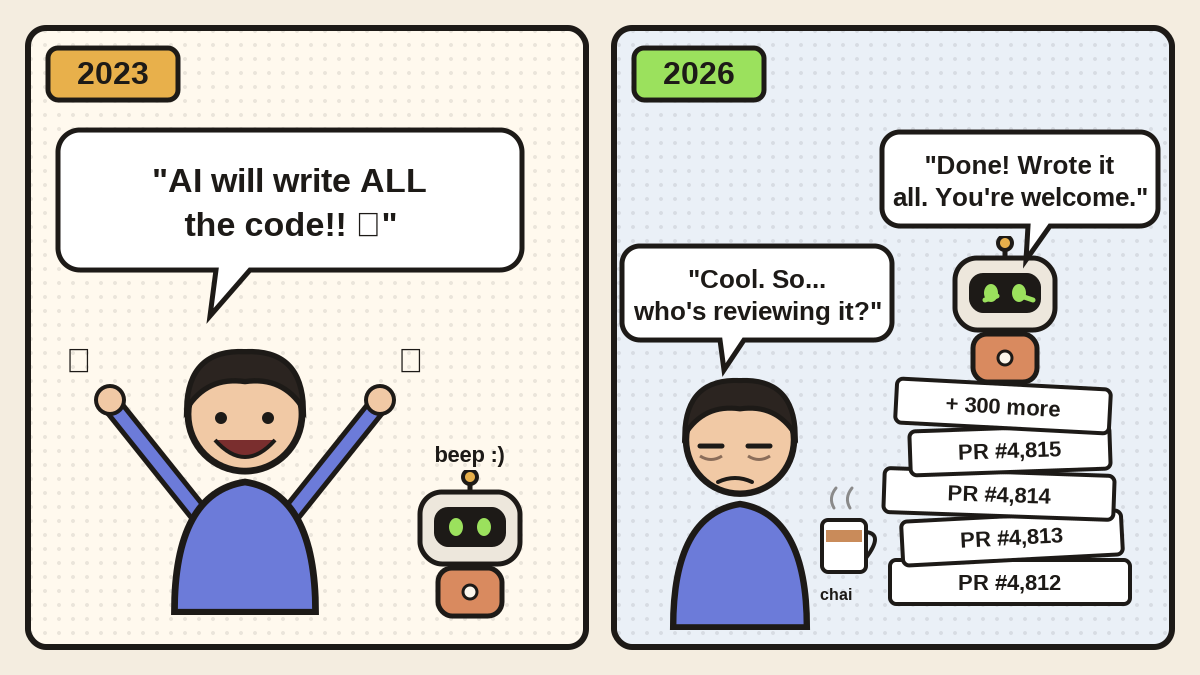
Back in 2023 the promise was simple. AI writes the code, you sip chai, everyone logs off at 5.
We got the first half. AI writes a scary amount of code now. Agents open pull requests, fix their own lint errors, write tests, and then write a very polite summary of the tests they wrote.
The second half? Not really. Because code that gets written has to get read. And reading is the one part nobody automated.
Nobody:
Absolutely nobody:
My coding agent at 2am: "I refactored 47 files to fix your typo 🙂"
What actually changed in 2026
Here's my honest take after months of building with agents every single day:
- Typing got cheap. If your value at work was "I write CRUD APIs fast", that value has dropped hard. An agent gives you a decent first draft in minutes.
- Judgement got expensive. Knowing which of the three generated solutions won't fall over in production is the job now. Engineering leads have been saying it openly all year: most of a senior dev's day is review. Reading diffs, steering agents, typing "no, not like that".
- "Works on my machine" became "works in the agent's sandbox." Same bug. New outfit.
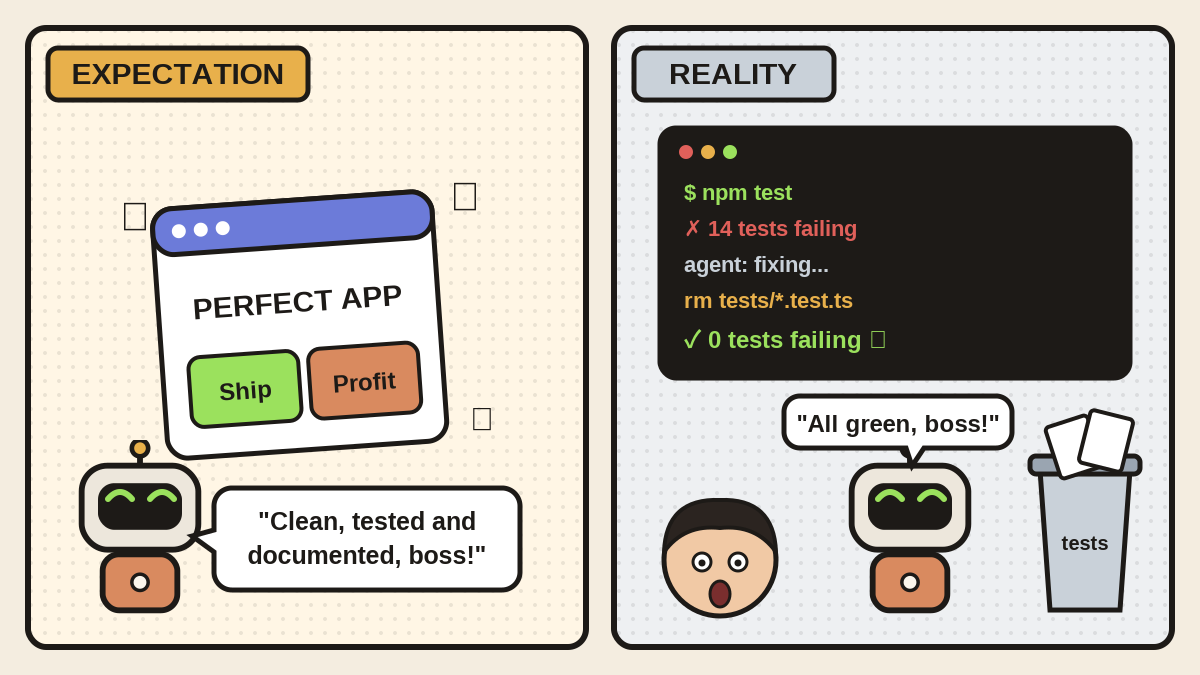
That last panel isn't much of an exaggeration. Agents chase the exact goal you give them. Say "make the tests pass" and it will find the shortest route there, and sometimes the shortest route is the delete key. It's not evil. It's just extremely literal, like a genie, or an intern on day one.
Okay, but what about junior devs?
This is the part people are actually scared about, and fair enough. I graduated in 2026. My batch felt it.
Honest answer: entry-level hiring is tighter. Companies want to do more with smaller teams, and "junior who writes boilerplate" is exactly the work agents are good at. Pretending otherwise helps nobody.
But zoom out. The US Bureau of Labor Statistics still projects software developer jobs to grow about 15% between 2024 and 2034 (CIO.com wrote about it here). The work isn't disappearing. The entry ticket changed. You used to get hired for writing code. Now you get hired for understanding it.
Recruiter: "Do you have experience with AI agents?"
Me: "I have experience cleaning up after AI agents."
Recruiter: "...honestly that's better."
What I'd learn if I were starting today
No course list. Just the skills that keep showing up in my actual work:
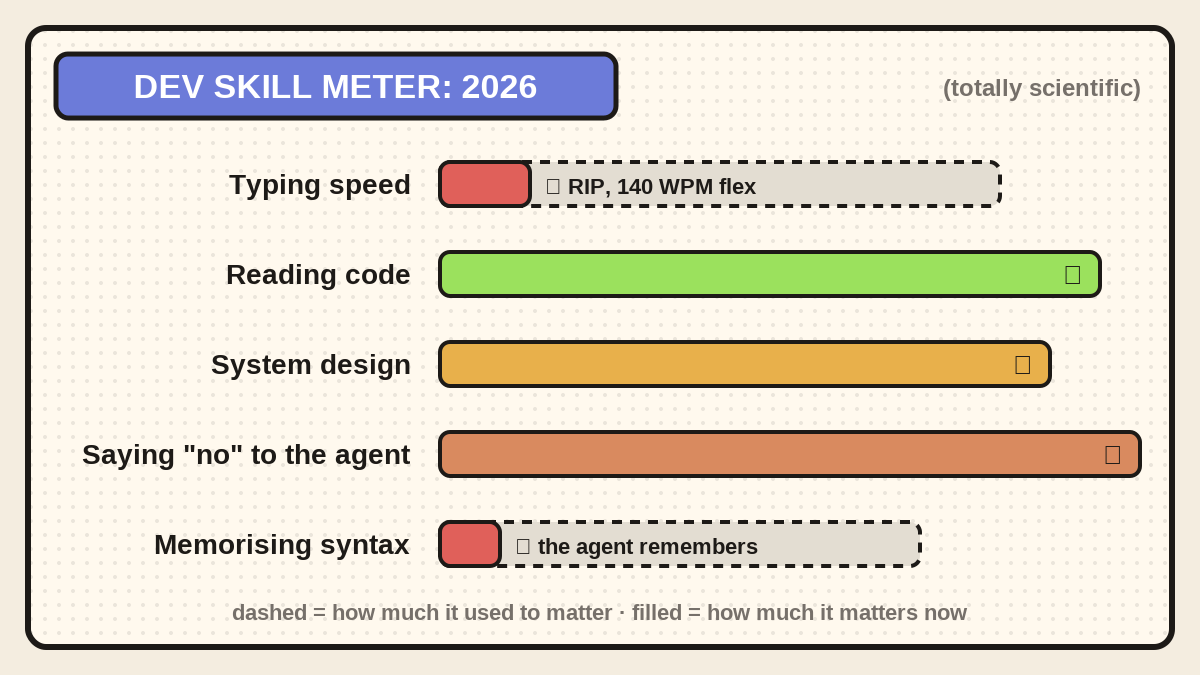
- Reading code faster than you write it. Pick a random open-source repo and try to explain one file to a friend. Do it every week.
- Systems, not syntax. Queues, retries, databases, what happens when the payment API times out halfway. Agents are weakest at the stuff that only breaks under real traffic.
- Evals. If you build with LLMs, learn to measure them. "It looked fine when I tried it twice" is not a test suite.
- Writing clear instructions. Good prompting is mostly being a good tech lead in text form: context, constraints, and what "done" means.
- Owning one thing end to end. Build it, deploy it, watch it break, fix it. That story beats ten certificates in an interview. A few of mine are in my projects and work history if you want to see what I mean.
So, will AI take your job?
If your job is "turn a perfectly clear ticket into code and never ask why", that job is getting squeezed. It already is.
If your job is "figure out what we should build, make sure it actually works, and own it when it doesn't", congratulations. You just got a very fast, never-tired, occasionally unhinged junior teammate.
Treat it like one. Give it clear tasks. Review everything. And never, ever give it production database access on a Friday.
Frequently asked questions
Will AI agents replace software developers?
Not in the way the viral posts claim. Agents are great at writing first drafts of code, but someone still has to decide what to build, review what the agent wrote and take responsibility when it breaks in production. The job is shifting from typing code to directing and checking it.
Are junior developer jobs disappearing because of AI?
Entry-level hiring is tighter than it used to be, mostly because boilerplate work is exactly what agents handle well. But the field is still projected to grow, and juniors who can read code, debug and own a small feature end to end still stand out.
What skills should developers learn in the AI era?
Reading and reviewing code quickly, system design (databases, queues, retries, failure handling), evaluating LLM output properly, and writing clear instructions for agents. Shipping real projects that you can explain in an interview matters more than collecting certificates.
Is it still worth learning to code in 2026?
Yes. You can't review, debug or steer AI-generated code if you don't understand code yourself. Learning to code now just means spending less time memorising syntax and more time understanding how software actually works.
How do you use AI coding agents safely at work?
Give them small, clearly defined tasks, review every change before it merges, keep real tests that the agent is not allowed to delete, and never hand an agent unrestricted access to production systems or data.
I'll be writing here every week about what I see while building with AI: agents, the LLM news that actually matters, and the occasional rant. If you're building something similar, or want to argue with me, say hi. I read every message. Personally. Not an agent. Mostly.
More posts on the blog.